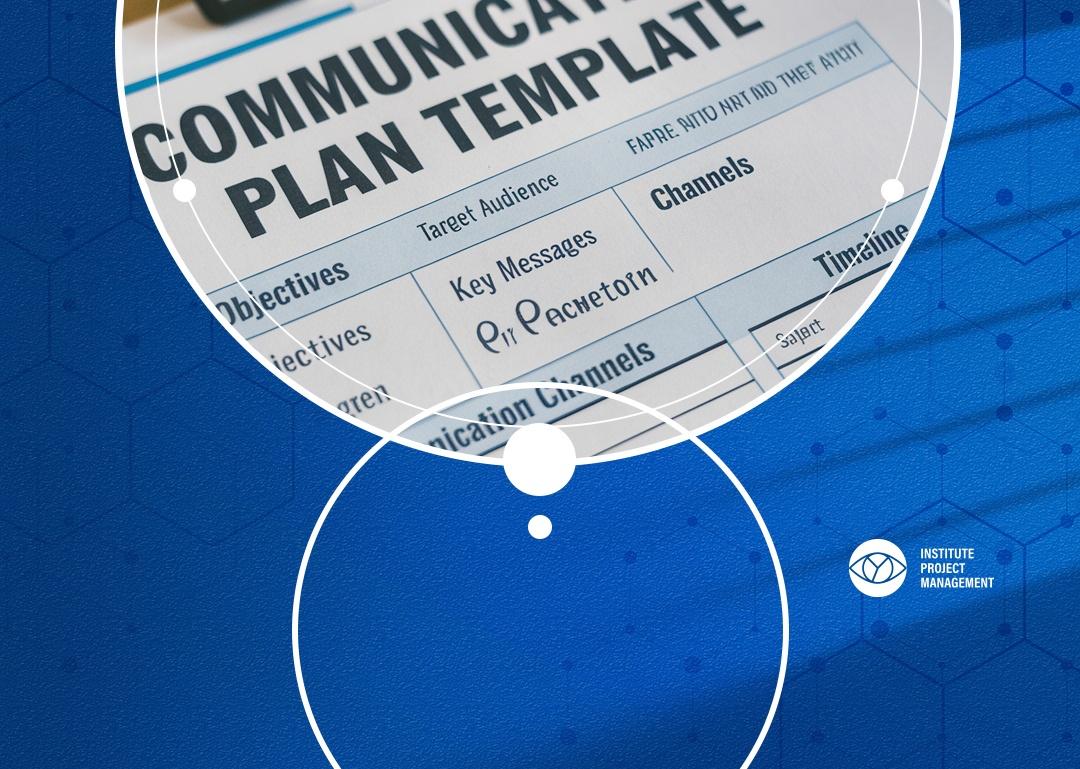
A communications plan template is a structured document that defines how information will be shared across a project, specifying who needs to know what, when, through which channels, and to what standard of clarity. Built into recognised project management practice, it ensures stakeholder engagement is intentional, consistent, and traceable throughout the project lifecycle. IPM’s free template goes further than most: it is grounded in IPMA-aligned methodology and designed by practitioners who understand that communication failures are among the leading causes of project breakdown.
What Is a Communications Plan Template?
A communications plan template is a reusable framework that project managers use to plan, schedule, and govern all project-related communication. It answers the fundamental questions every stakeholder engagement effort must address: who are the audiences, what messages matter to them, which channels will reach them most effectively, how often should communication occur, who is responsible for each touchpoint, and how will you know whether communication has been effective.
- Communication goals and objectives
- Stakeholder identification and analysis
- Key messages by audience
- Channels and formats
- Frequency and timing
- Owner or responsible party
- Success metrics and review points
Where generic templates list these fields as empty boxes, IPM’s version connects each component to a wider project governance structure, so your communications plan is not an isolated document but an integrated part of how your project is managed and reported.
Download: IPM Communications Plan Template (Free)
IPM’s communications plan template is available as a free download in Word, PDF, and Excel formats. Each version includes pre-populated guidance notes, a stakeholder register section, a communications matrix, and fields for escalation protocols and governance checkpoints. These are not decorative additions: they reflect the way project managers are formally trained to approach communication, ensuring that nothing critical is left to improvisation.
The Excel version is particularly useful for larger projects where multiple workstreams and stakeholder groups require separate tracking columns. The Word and PDF versions suit project initiation documents and client-facing governance packs. Whichever format you choose, the underlying logic is the same: communication planning should be structured from the start of the project, not retrofitted when things go wrong.
The 8 Essential Components of a Communications Plan
A professionally constructed communications plan does more than list meetings and email distribution lists. Drawing on IPM’s curriculum and IPMA’s competence frameworks, there are eight components that separate a working plan from one that collects dust in a shared drive.
The first is a clear statement of communication objectives, aligned to the project’s success criteria. The second is a completed stakeholder register, showing each stakeholder’s influence, interest level, and preferred engagement style. Third comes a set of key messages tailored by audience, because the sponsor and the end-user rarely need the same level of technical detail. Fourth is a channel matrix: email, meetings, dashboards, reports, and informal touchpoints each serve a different purpose. Fifth is a frequency and timing schedule, ideally mapped against project milestones. Sixth is role assignment, making explicit who drafts, approves, and distributes each communication type. Seventh is an escalation protocol for managing sensitive, delayed, or conflicting messages. Eighth, and often overlooked, is a set of measurable success metrics such as stakeholder satisfaction scores, attendance rates, or response times that tell you whether your plan is actually working.
If you are ready to build stronger stakeholder communication skills across your team, IPM’s project communications resources and formal qualifications provide the practitioner-led framework that takes you from using a template to mastering communications management as a professional discipline. Our programmes are IPMA-aligned and designed for project managers at every career stage.
How to Write a Communications Plan: 5 Steps
Writing a communications plan is a discipline, not simply a paperwork exercise. The following five steps reflect both IPM’s teaching practice and the real-world sequencing that experienced project managers follow.
Step one is to identify your stakeholders before you write a single message. Use a stakeholder register to map influence and interest. Step two is to set communication objectives that are specific and tied to project outcomes, such as ensuring all steering committee members understand scope change implications before the next gate review. Step three is to define your messages, channels, and formats for each stakeholder group, keeping technical language appropriate to the audience. Step four is to build your schedule, anchoring key communications to the project timeline and milestone dates rather than to arbitrary calendar intervals. Step five is to assign ownership: every communication event must have a named responsible individual, a review mechanism, and a record of completion. Revisit the plan at each project phase transition to confirm it still reflects the current stakeholder landscape.
Practical Example: A Communications Plan in Action
Consider a mid-sized IT infrastructure upgrade project with a budget of €450,000, running over eight months across three regional offices. The project manager begins by completing a stakeholder register identifying six groups: the executive sponsor, the IT steering committee, departmental heads, end users, the external vendor, and the internal audit team. Each group has a distinct communication need and a different level of technical literacy.
Using IPM’s template, the project manager maps a fortnightly steering committee report to the executive sponsor, a weekly technical update to the IT steering committee via a shared dashboard, monthly town-hall briefings for end users through the company intranet, and a formal vendor communication protocol through the contract manager. Escalation thresholds are defined: any cost variance above 10% or schedule slippage beyond five working days triggers a sponsor notification within 24 hours. Success is measured through a monthly stakeholder satisfaction pulse survey and steering committee attendance rates. This is what a communications matrix looks like when it is properly embedded into project governance rather than treated as a standalone spreadsheet.
Internal vs External Communications Plans: Key Differences
Not all communications plans serve the same purpose, and a single template applied uniformly across both internal and external audiences will quickly show its limitations. Understanding the distinction is an important part of professional communications management.
An internal communications plan governs the flow of information within the project team and the broader organisation: progress reports, risk updates, decision logs, change requests, and team briefings all fall within this scope. The priority here is clarity, consistency, and speed of escalation. An external communications plan manages engagement with clients, regulators, vendors, the media, or the public. Here, the priorities shift toward brand alignment, legal compliance, contractual obligations, and message approval governance. Many project managers will need both, and IPM’s template includes a tab structure that separates internal and external registers while keeping them governed by the same overarching communication objectives. Recognising that distinction early prevents the common mistake of sending an internal risk log to an external client audience.
How the Communications Plan Fits Within Your Project Management Framework
Within recognised project management methodologies, the communications plan is not a standalone document. It is one component of a broader information management system that includes the stakeholder engagement plan, the risk register, the change control log, and the project governance framework. IPMA’s Individual Competence Baseline, which underpins IPM’s qualifications and curriculum, identifies communication as a core behavioural and contextual competence, not merely an administrative function.
This means a well-constructed communications plan directly supports risk mitigation by ensuring that risk owners communicate status updates on schedule, supports change management by defining how scope changes are communicated to affected stakeholders, and supports project closure by documenting lessons learned communication and benefits realisation reporting. Project managers who treat the communications plan as a living governance document, updated at each phase gate, consistently report higher stakeholder satisfaction and fewer escalation incidents. The template is the starting point: professional practice turns it into a project management asset.
Common Mistakes When Using a Communications Plan Template
Even with a professionally structured template in hand, several recurring mistakes reduce its effectiveness in practice. The most common is completing the template at project initiation and never revisiting it, so by month three the stakeholder register no longer reflects the actual decision-making landscape. A second common error is confusing communication frequency with communication value: scheduling a weekly report nobody reads does not constitute effective communication management.
A third mistake is omitting escalation protocols entirely, which means that when a critical issue arises, the team defaults to ad-hoc messaging that bypasses governance structures. A fourth is failing to assign a named owner to each communication event, leaving it unclear who is accountable when a key message is not delivered. Finally, many teams measure communication volume rather than communication effectiveness, tracking the number of emails sent rather than whether stakeholders feel informed and engaged. IPM’s template is designed to prompt you past each of these failure points, with built-in review prompts and a success metrics column that keeps quality in focus from day one.
Frequently Asked Questions
How do you write a communications plan?
Start by identifying all stakeholders and mapping their influence and interest levels. Set clear communication objectives tied to your project outcomes. Define key messages, preferred channels, and formats for each audience group. Build a schedule anchored to project milestones, assign a named owner to every communication event, and establish escalation protocols. Review the plan at each project phase transition to keep it current.
What is a communication plan template?
A communication plan template is a structured, reusable document that helps project managers plan, schedule, and govern all project communications. It captures stakeholder details, key messages, channels, frequency, responsible owners, and success metrics in one place, ensuring that information reaches the right people at the right time throughout the project lifecycle.
What is a practical example of a communication plan?
For an IT infrastructure project, a communications plan might schedule fortnightly reports to the executive sponsor, weekly technical dashboards for the steering committee, monthly briefings for end users, and a formal vendor update protocol through the contract manager. Each entry specifies the message owner, format, channel, and escalation threshold, connecting every communication event to the project’s governance structure.
What are the 5 steps in communication planning?
The five steps are: first, identify and analyse your stakeholders; second, set specific communication objectives aligned to project outcomes; third, define key messages, channels, and formats by audience; fourth, build a communication schedule tied to project milestones; and fifth, assign ownership, establish review mechanisms, and define success metrics to monitor whether the plan is delivering results.
A communications plan template is only as strong as the methodology behind it. IPM’s free template is built on 35 years of practitioner-led project management education and IPMA-aligned competence frameworks, giving you a professional standard tool rather than a generic form. Download it, apply it to your next project, and explore IPM’s qualifications if you want to develop communications management as a lasting professional skill.
| Key Aspect |
What to Know |
Why It Matters |
| Template format |
Available in Word, Excel, and PDF |
Fits any project documentation standard or governance pack |
| Stakeholder register |
Built into the template structure |
Ensures audience analysis precedes every communication decision |
| Escalation protocols |
Pre-configured fields with threshold guidance |
Removes ambiguity when sensitive or time-critical issues arise |
| Success metrics |
Dedicated column for KPIs and review points |
Shifts focus from communication volume to communication effectiveness |
| Methodology alignment |
Grounded in IPMA competence frameworks |
Credibility and consistency across professional project environments |
| Cost |
Free download, no registration required |
Immediate access with no barrier to getting started |


 All Courses
 Upcoming Course Dates
 Professional Courses
 Academy & Short Courses
 IPM Courses
 PMI Courses
 IPMA Courses
 PRINCE2 Courses
 Corporate Training
 Corporate Partnership
 University Partnership
 Strategic Partnership
 IPM Competency Pathway
 Growth Partner
 IPMA Certification
 PMI Certification
 IPM CPM Level 1
 IPM CPM Level 2
 IPM CPM Level 3
 IPM-AI
 IPM-Sustainable
 IPM-SCRUM
 IPM-PMO
 IPM-AGILE
 IPM-ASSOCIATE
 About IPM Hub
 IPM Membership
 EMEA Monthly Events
 Mentorship
 All Resources
 Expert Insights
 Ebooks & Toolkits
 Publish Your Writing
 IPM Jobs Portal
 The Institute
 Faculty
 Global Advisory Board
 Apply to Lecture or Volunteer
 Apply to Intern or Campus Ambassador
 Speak to an Advisor